Odds are a few marketing blogs have already told you to hire a medical copywriter. But you're no dummy... before you spend a dime, you want to know what that project looks like week by week and how much of your staff's time it's going to eat.
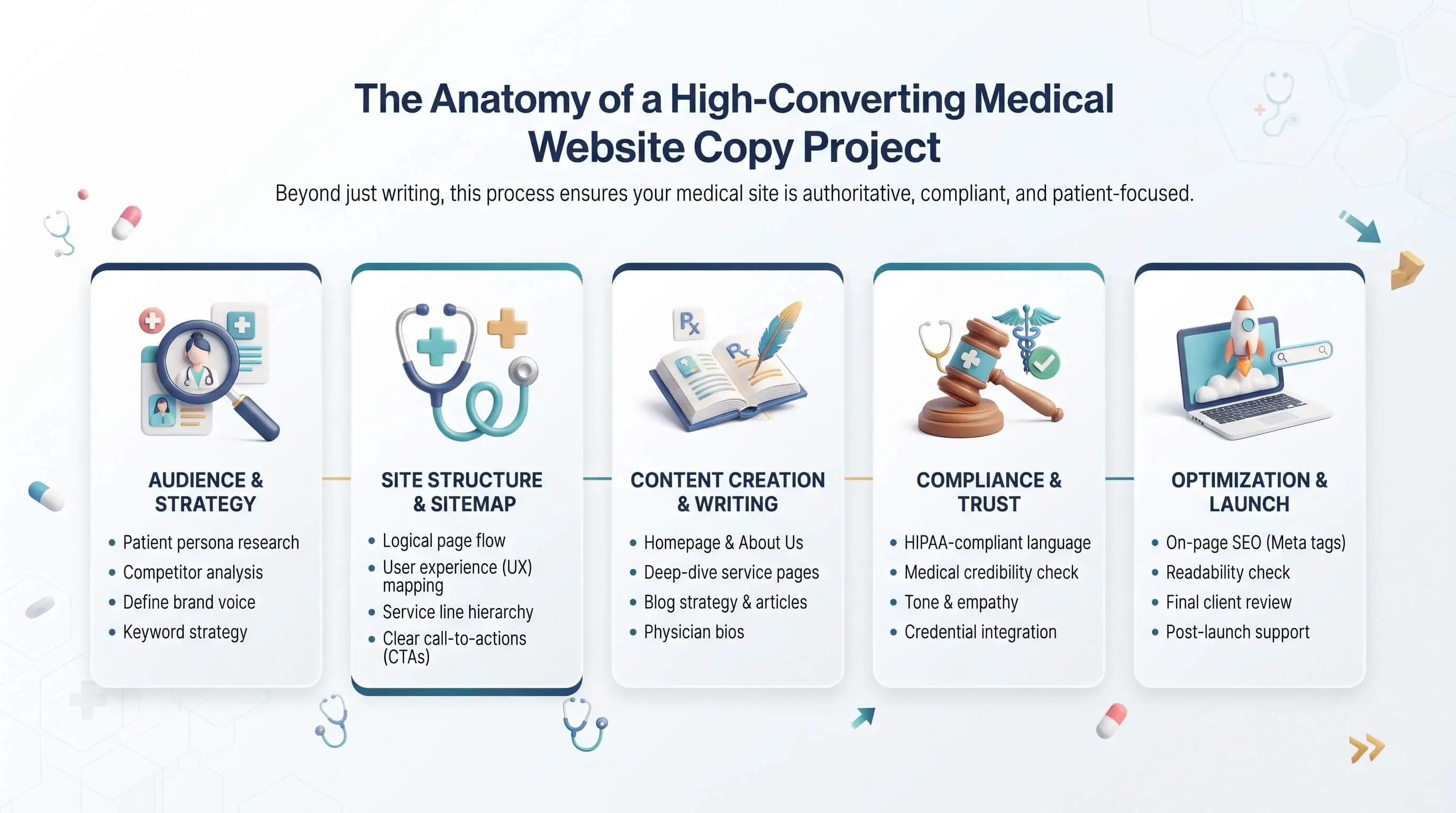
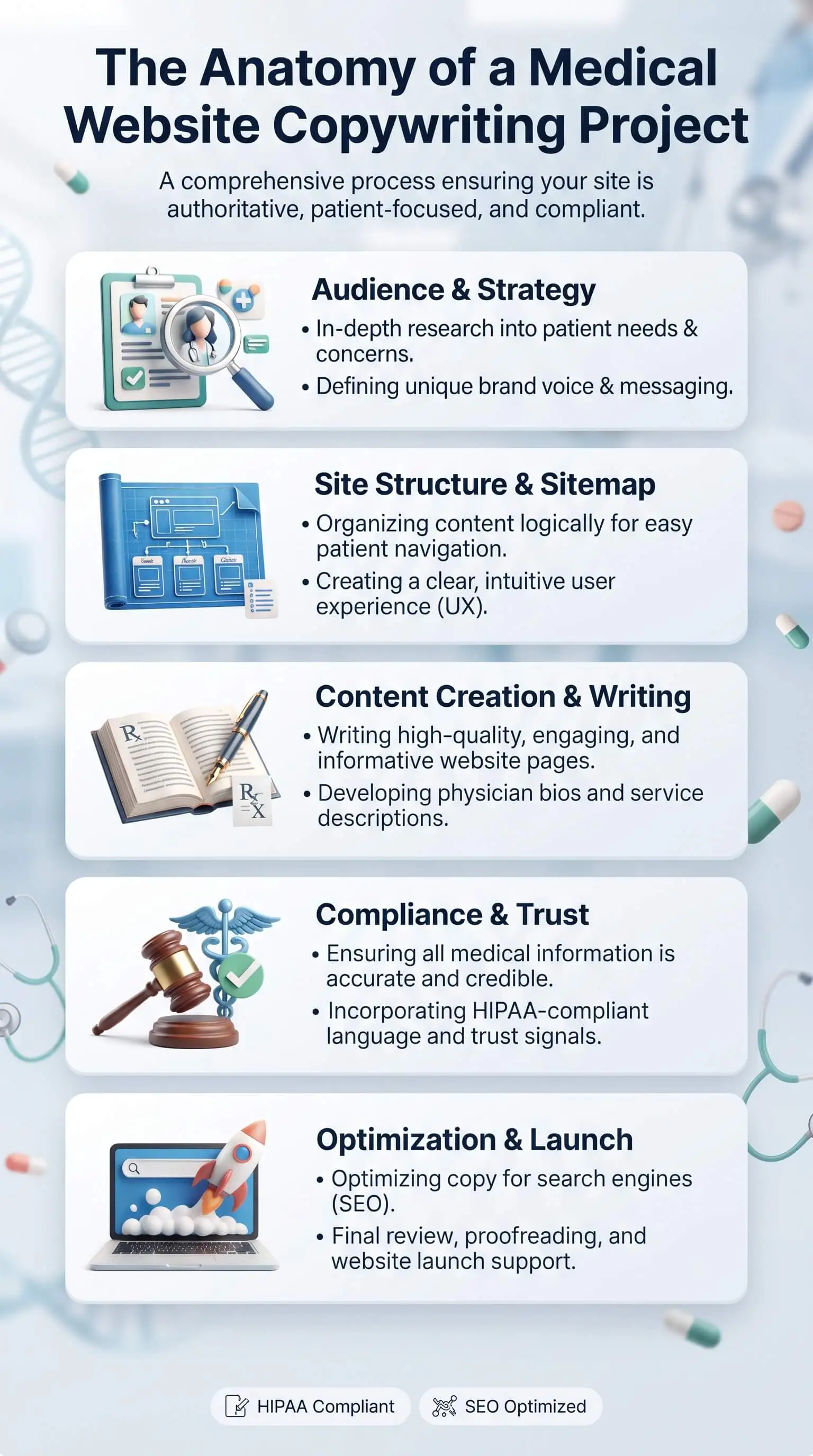
Fair enough. A medical website copywriting project moves through seven phases: discovery, research, page planning, drafting, medical and compliance review, revisions, and SEO finishing. Each one needs something from you, and each one comes with a couple of medical copywriting tips that save you time.
TL;DR Quick Answers
Medical Copywriting Tips
The best medical copywriting tips start from one idea. A copywriter is a salesman who writes, but in healthcare the reader is often scared, so clarity has to come before persuasion. On a clinic website, that looks like this:
Lead with the patient's worry. "Not sure if your burn needs a doctor?" beats "Founded in 2009" every time.
Write to one reader in plain words. Talk to "you" in short sentences, with no jargon you wouldn't use in the exam room.
Trade adjectives for specifics. A named source or a clear next step does more than "world-class care."
Research before you write. Most of a good project is checking what patients search for and what each claim rests on.
Promise only what you can prove. Cut "guaranteed" and "pain-free," and get HIPAA authorization before any testimonial goes live.
Get a provider's sign-off. The writer flags the claims, but the clinic owns what gets published.
Top Takeaways
Expect seven phases. Discovery, research, page planning, drafting, medical and compliance review, revisions, and SEO finishing.
Plan for research to take longer than writing. Send your intake answers and patient questions early.
Have a provider sign off on accuracy. I flag the claims, but your clinic owns what gets published.
Send one set of notes per round. One person gathering feedback keeps revisions to two clean rounds.
Promise only what you can prove. Skip "cure" and "guaranteed." Specific, honest claims earn more trust and more calls.
What Medical Website Copywriting Is (And Where It Stops)
Simply put, copywriting is sales writing. Its job is to get a reader to do something. Medical copywriting keeps that job and piles two more on top of it... be accurate, and stay compliant. On a clinic website, every page has to survive your provider's red pen and still get a worried patient to book.
What it usually does not cover is web design, development, photography, or hosting. Those are separate line items. If a quote lumps them all together, ask who's doing which piece. You'd be surprised how often the answer starts with "uh..."
The 7 Phases of a Medical Website Copywriting Project
Almost every clinic project I run follows the same seven phases in the same order. Here's who does what in each one.
Phase 1, Discovery. We talk about goals, services, ideal patients, and the competitor down the street. You send intake answers and your most common patient questions, and I send back a project scope and page list.
Phase 2, Research. I dig into keywords, search intent, and clinical sources. You give me access to whatever materials you already have. You get a keyword map and a source list.
Phase 3, Page plan. I build the sitemap and outline each page around one topic. Once you approve the plan, every page gets its own content brief.
Phase 4, Drafting. The actual writing. Your job here is mostly patience.
Phase 5, Review. A provider on your team checks medical accuracy while I chase down a source for every claim.
Phase 6, Revisions. You send one combined set of notes per round, and I turn them into a final copy.
Phase 7, SEO finishing. Meta tags, alt text, internal links, and a clean handoff file for your developer.
Phase 1: Discovery and Intake
This is a discovery call plus an intake questionnaire. I want to know which services keep the lights on and which competitor keeps winning the patients you should be getting.
For our burn clinic, the big question is the audience. Is the site for the person with a fresh kitchen burn at 9 p.m., or the patient six months out who's worried about scarring? Each one needs different pages. And if physician referrals matter to you, that's a whole other set.
Tip: Send me the ten questions your front desk answers most often. They turn into pages and FAQs almost word for word.
Phase 2: Research
This surprises a lot of people, but when you're a good copywriter, you don't spend most of your time writing. Research eats the biggest chunk of every project I run. I'm checking what patients type into Google and what your competitors already rank for. Then I track down a clinical source for every claim you want to make.
For the burn clinic, a search like "how long does a second-degree burn take to heal" is a patient education question. It belongs on a helpful article, not buried halfway down the scar treatment service page.
Phase 3: Page Plan and Content Brief
Before I write a single sentence, you approve a sitemap and an outline for each page. One main topic per page, with one clear call to action.
Why so strict? A page that tries to cover burns, chronic wounds, and skin grafts all at once usually ranks for none of them. Google and AI answer tools both favor pages that answer one question well.
Phase 4: Drafting the Copy
Now the writing. I write to one reader in plain words, and I lead with their worry instead of your credentials.
Here's a before and after from the burn clinic's "when to seek care" page:
Before: "Our multidisciplinary burn team provides expert evaluation of thermal injuries of varying severity."
After: "Not sure if your burn needs a doctor? If it's bigger than your palm, blistering badly, or on your face, hands, or joints, call us today."
The first one sounds like a brochure. The second sounds like a nurse on the phone, and it tells the reader exactly what to do next. (For the medical side of that question, this site's guide on when a second-degree burn needs the ER goes deeper.)
If you want the line-by-line habits behind a strong draft, I've collected my medical copywriting tips on plain language, proof, and HIPAA-safe testimonials in one post.
Phase 5: Medical and Compliance Review
I will write about it. A licensed provider on your team checks it. That split matters, because the clinic carries the liability for what goes live, not the writer.
During review, I flag every claim that needs a source. I soften or cut words like "guaranteed" and "pain-free." And any patient testimonial or before-and-after photo needs written HIPAA authorization before it touches your site. HIPAA is VERY important here, because regulators count fines per violation.
Phase 6: Revisions
Most projects include two consolidated rounds of revisions. That word "consolidated" is doing a lot of heavy lifting.
Tip: Pick one person to collect everyone's notes. When the office manager, the medical director, and the owner's spouse all email separate edits, everybody pulls the copy in a different direction and the timeline doubles. (Ask me how I know.)
Phase 7: SEO Finishing and Handoff
The last stretch covers meta titles and descriptions, image alt text, internal links, and a tidy handoff file for whoever builds the site. After launch, plan to refresh your most important pages at least twice a year so the site doesn't go stale.
Medical Copywriting Tips for Getting More From Your Project
The practices that get the best results tend to do the same handful of things:
Name one decision-maker. Committees write brochures. One person can sign off on a website.
Answer intake questions within a week. Every week of delay at the start shows up again at the end.
Book review time up front. Two hours on your medical director's calendar keeps a project from stalling for a month.
Share your own photos. Stock images of grinning doctors undercut good copy faster than a typo.
Be honest about outcomes. A copy that can't overpromise reads as more trustworthy.
Ask for the source list. A good writer keeps one, and you should have a copy.
Red Flags When Hiring a Medical Copywriter
Walk away if a writer guarantees rankings or a set number of new patients. Same goes if they never ask who reviews for medical accuracy, or never once bring up HIPAA. In most industries those are small oversights. In healthcare, they're liabilities with your clinic's name on them.
"Every clinic I work with expects the writing to be the hard part. It almost never is. The hard part is the week we spend deciding who a page is for and which claims we can prove. My favorite moment in any project is when a provider reads a draft and says, 'That's exactly what I tell patients in the exam room.' That's when I know the research paid off. And when a project stalls, it's almost always because nobody owns the review. Put one name on that job before we start, and a seven-week project stays a seven-week project."
Essential Resources
These are the seven I keep open in a browser tab during almost every clinic project. Skim the ones that match the phase you're in.
1. See What Plain Language Looks Like on a Page
Digital.gov's plain language series shows how to write, design, and test content so the people it's meant for can follow it. I lean on it every single time I start drafting.
Source: Digital.gov: Plain Language Guide Series
2. Plan Your Pages Around the Patients You Want
The NIH's Clear & Simple guide lays out five steps for building health materials, starting with defining and researching your audience. It lines up almost perfectly with the discovery and research phases.
Source: NIH: Clear & Simple
3. Write Pages a Patient Can Read on the First Try
MedlinePlus walks through planning, writing, and testing easy-to-read health materials, and suggests aiming for about a 7th or 8th grade reading level. Hand it to whoever on your team reviews drafts.
Source: MedlinePlus: How to Write Easy-to-Read Health Materials
4. Know Which Claims Need Proof Before You Make Them
The FTC says health claims have to be truthful, not misleading, and backed by competent and reliable scientific evidence. I treat this page as my checklist during compliance review.
Source: FTC: Health Products Compliance Guidance
5. Use Patient Stories Without Breaking HIPAA
HHS explains when a communication counts as marketing and when you need a patient's written authorization first. Read it before a single testimonial goes on your site.
Source: HHS: HIPAA Privacy Rule and Marketing
6. Make the Site Easy for Everyone to Use
The W3C's writing tips cover descriptive page titles, clear headings, meaningful link text, and alt text. Those same habits help search engines and AI tools figure out what each page is about.
Source: W3C: Writing for Web Accessibility
7. Find Out What Google Wants From a Clinic Site
Google's guide to people-first content explains how its systems weigh experience, expertise, and trust, and why health topics get extra scrutiny. It's the shortest honest answer I know to "what does Google want from us?"
Source: Google Search Central: Creating Helpful, Reliable, People-First Content
Supporting Statistics
Three numbers that explain why every phase above exists, pulled from U.S. government and National Academies sources. None of them repeat the resources above.
1. 58.5% of U.S. Adults Look Up Health Information Online
Between July and December 2022, 58.5% of U.S. adults used the internet to look for health or medical information. For a lot of future patients, your website is the first "appointment" they ever have with you. That's why I don't rush the research phase.
Source: CDC/NCHS Data Brief No. 482: Health Information Technology Use Among Adults
2. About 36% of U.S. Adults Have Basic or Below Basic Health Literacy
In the national health literacy assessment, about 22% of adults scored at the Basic level and another 14% scored Below Basic. Put those together and more than a third of your readers may struggle with a dense service page. On a clinic site, plain language is the whole job.
Source: NCES: The Health Literacy of America's Adults
3. Nearly 90 Million Americans Have Trouble Understanding and Using Health Information
The Institute of Medicine reported that nearly half of American adults have a hard time understanding and using health information. It also cited more than 300 studies showing that health materials are often too hard for the people they're written for. Good medical copy exists to close exactly that gap.
Source: National Academies: 90 Million Americans Are Burdened With Inadequate Health Literacy
With 58.5% of U.S. adults searching online for health information and millions struggling to understand complex medical content, a copywriter Spokane WA healthcare providers work with can help create clear, accurate, and accessible website copy that builds patient trust and makes health information easier to understand.
Final Thoughts and Opinion
A medical website copywriting project is a decision-making project that happens to end in writing.
After years of doing this for clinics, I can usually tell by week two whether a project will run smoothly or turn into a slog. The smooth ones answer intake questions fast and put medical review on the calendar like a patient appointment. The slogs treat review as something to squeeze in between patients... and then wonder why the launch keeps sliding.
I'll be straight with you. If your site has fewer than five pages and your services haven't changed in years, you may not need a full project. A focused rewrite of your homepage and your top service page might do more for less money, and I'll tell you that on the first call.
But if you're adding services or losing patients to a competitor with a better site, a structured project pays for itself. Same goes if nobody remembers who wrote your current copy. You'll know exactly what you're getting and when it's done.
For the burn clinic in our example, the payoff is simple. Someone with a blistering burn at 9 p.m. finds a page that tells them, in plain words, whether to come in tonight. That's the point of the whole thing.
Frequently Asked Questions
Q: What Does a Medical Copywriter Do on a Website Project?
A: They research, plan, and write every page so it's accurate and still persuasive. That covers keyword research, page outlines, drafts, flagging claims for medical review, and finishing details like meta descriptions. Think of them as the person who turns what you say in the exam room into words that work online.
Q: How Long Does a Medical Website Copywriting Project Take?
A: Mostly it depends on page count and how fast reviews come back. In my experience, a small practice site of 8 to 12 pages runs about six to eight weeks. When a project runs long, slow medical review is usually why.
Q: What Do I Need to Give My Copywriter?
A: Answers to an intake questionnaire, your service list, your most common patient questions, and access to anything you've already got. You'll also need one provider who can check drafts for accuracy. And photos of your own team help more than you'd think.
Q: Who Is Responsible for Medical Accuracy?
A: Your clinic is. A good copywriter researches carefully and flags every claim that needs support, but a licensed provider on your team signs off. If something misleading goes live, the organization carries the liability, not the writer.
Q: How Many Rounds of Revisions Are Normal?
A: Two consolidated rounds is typical. That means one combined set of notes per round, not five separate emails from five people in the office. That single habit keeps most projects on schedule.
Q: Is SEO Part of Medical Website Copywriting?
A: It should be. Keyword research shapes the page plan, and the meta titles, descriptions, headings, and alt text get written right alongside the copy. If a quote leaves SEO out entirely, ask why.
Ready to Plan Your Medical Website Copy?
You don't need a bigger marketing budget. You need pages that turn worried searchers into booked patients. Grab a free 15-minute call with Riley James Copy, and we'll map out what your project should include. No pitch attached.
Riley Rath is a medical copywriter at Riley James Copy, writing website copy, blog posts, email, and ads for private practices and healthcare marketing agencies. Example copy in this article is illustrative and is not medical advice.


